

Licensing
You can test both developer and organization features for free. However, to remove watermark from React PDF, a valid license is required. Please purchase a commercial license
Manage a License Key
Section titled “Manage a License Key”A license key is a unique key that unlocks React PDF for a domain, subdomain, or IP address. It authenticates your licensed usage and removes the watermark in the viewer.
After purchasing a license, you will receive an email with instructions on how to generate license keys for your corresponding domains. Each key must be bound to a corresponding domain, subdomain or IP address.
You could also access the License Manager page directly to create and manage your keys.
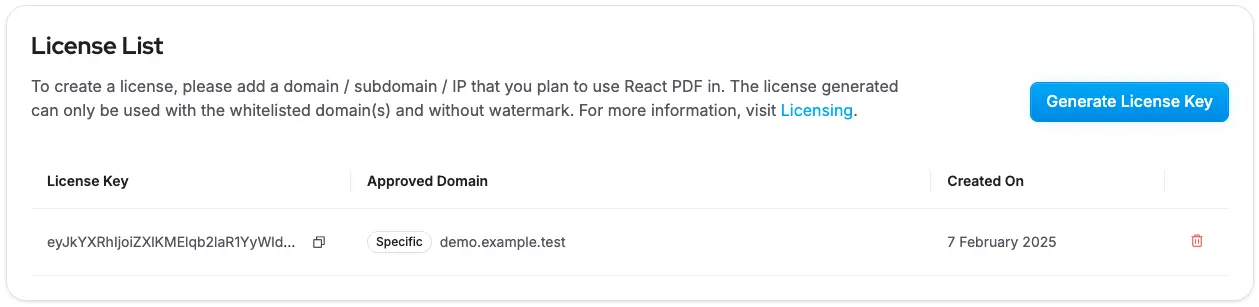
On the Manage License Key page, you can generate multiple keys per license. However, each token can only be linked to a single domain or subdomain/IP, using one of the following types: Specific Host and Wildcard.
Specific Host
Section titled “Specific Host”A specific host license key binds to an exact domain, subdomain or IP address. Accepted values include:
- Localhost (e.g.,
localhost:3000,localhost:5173) for local development - Domain names (e.g.,
test.example.com,www.example.com) - IP addresses and non-standard ports (e.g.,
192.168.1.1,127.0.0.1:5173)
⚠️ Only exact matches are supported. For example, a token for
example.comwill not cover subdomains likewww.example.comorxyz.example.com. These must be added separately.
Wildcard
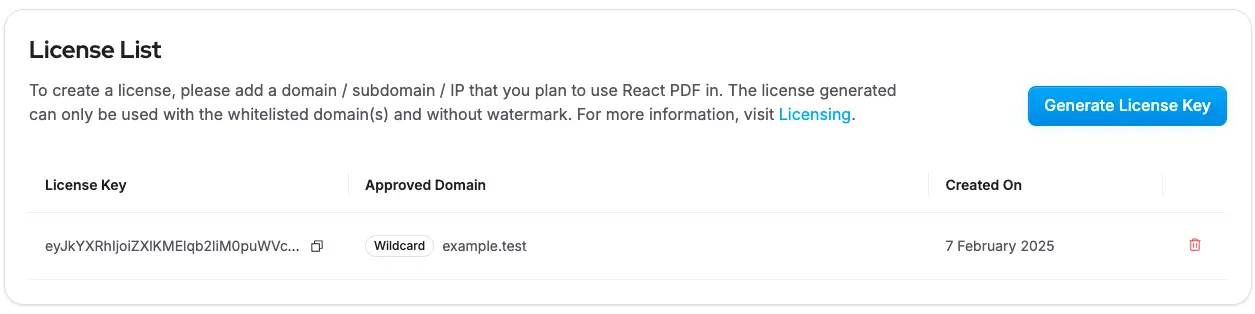
Section titled “Wildcard”Wildcard is only available with an Organization license.
A Wildcard license key binds to a single root domain and automatically includes all of its subdomains.
For example, a key binded to your-domain.com will also cover:
app.your-domain.comdev.your-domain.comadmin.your-domain.com
Remark: For more details, refer to the License Agreement
Use a license key
Section titled “Use a license key”After creating a license key for your domain on the License Manager page, here is how you can add a license key in your project.
import { RPConfig } from '@pdf-viewer/react'import AppPdfViewer from './AppPdfViewer'
const YOUR_LICENSE_KEY = ''
function App() { return ( <RPConfig licenseKey={YOUR_LICENSE_KEY}> {/* A reusable React PDF viewer component */} <AppPdfViewer /> </RPConfig> )}export default Appimport { RPConfig } from '@pdf-viewer/react'import AppPdfViewer from './AppPdfViewer'
const YOUR_LICENSE_KEY = ''
function App() { return ( <RPConfig licenseKey={YOUR_LICENSE_KEY}> {/* A reusable React PDF viewer component */} <AppPdfViewer /> </RPConfig> )}export default AppUse License Keys for Different Environments
Section titled “Use License Keys for Different Environments”If you have different environments for your project, you may set up an .env file to config one license key per environment.
Step 1: Define Environment Variables
Section titled “Step 1: Define Environment Variables”React vite
Section titled “React vite”# .env.developmentVITE_RP_LICENSE_KEY="Your Dev License Key"
# .env.stagingVITE_RP_LICENSE_KEY="Your Staging License Key"
# .env.productionVITE_RP_LICENSE_KEY="Your Prod License Key"Nextjs
Section titled “Nextjs”# .env.developmentNEXT_PUBLIC_LICENSE_KEY="Your Dev License Key"
# .env.testNEXT_PUBLIC_LICENSE_KEY="Your Test License Key"
# .env.productionNEXT_PUBLIC_LICENSE_KEY="Your Prod License Key"Step 2: Configure Each Key in CI/CD Pipeline
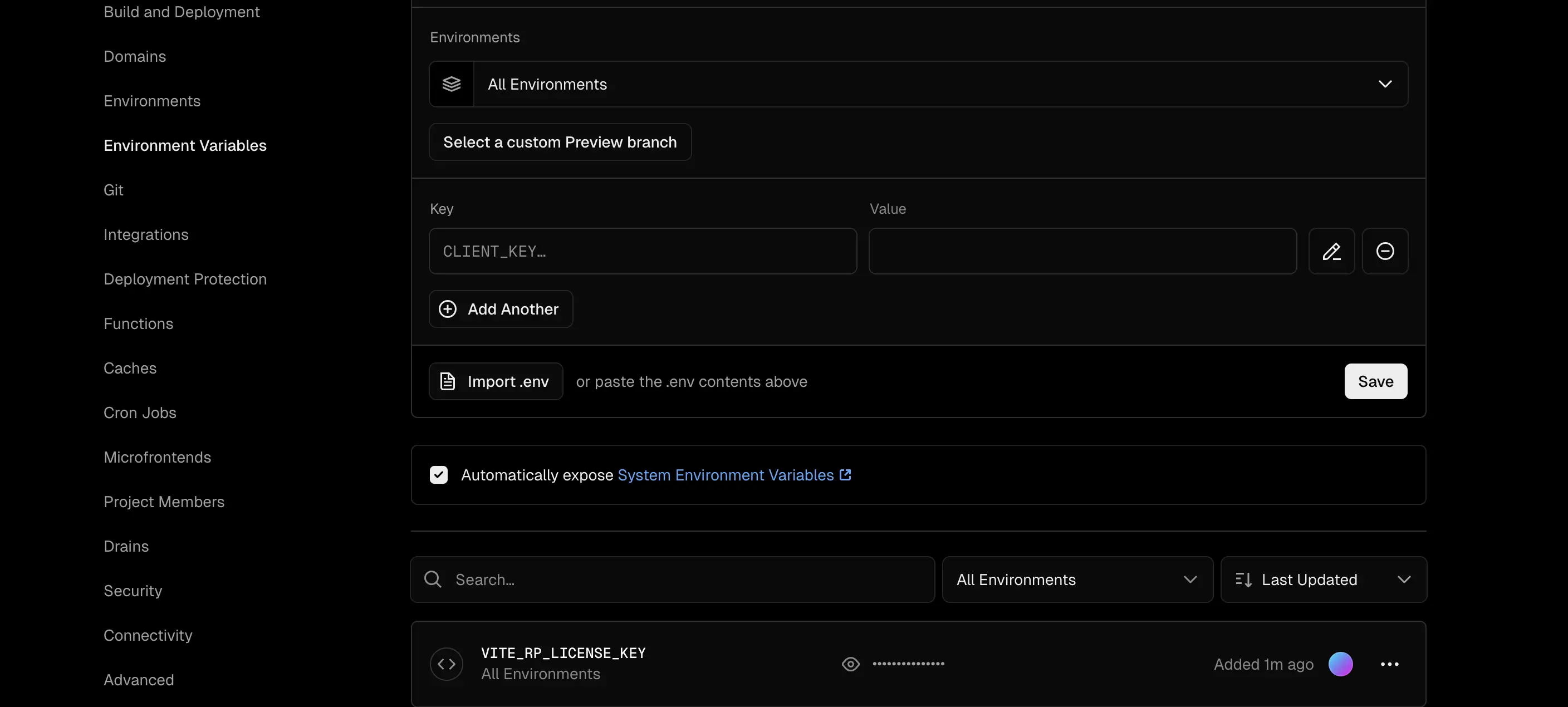
Section titled “Step 2: Configure Each Key in CI/CD Pipeline”After defining environment variables for each environment, you can configure them in your CI/CD pipeline so your application can access the correct license key per environment.
Example: Vercel Configuration
- Navigate to your Vercel project → Settings → Environment Variables
- Add the following variables for each environment:
Step 3: Import license key
Section titled “Step 3: Import license key”Import license key from .env and use it on RPConfig
React vite
Section titled “React vite”const LICENSE_KEY = import.meta.env.VITE_RP_LICENSE_LKEY
<RPConfig licenseKey={LICENSE_KEY}> ... <AppPdfViewer /></RPConfig>Nextjs
Section titled “Nextjs”const LICENSE_KEY = process.env.NEXT_PUBLIC_RP_LICENSE_LKEY
<RPConfig licenseKey={LICENSE_KEY}> ... <AppPdfViewer /></RPConfig>Use License Keys for Multiple Domains
Section titled “Use License Keys for Multiple Domains”If your application needs to run on multiple domains or subdomains, you could map the license keys on the client-side or server-side to authenticate the license and remove watermark.
For example, you have a Viewer Organization license and you are running an application that serves clients with different domains:
- Domain 1: example.com
- Domain 2: classic-example.com
- Domain 3: complex-example.com
Front-End Implementation
Section titled “Front-End Implementation”import { RPConfig, RPPages, RPProvider } from "@pdf-viewer/react";
const licenseKeyMap: Record<string, string> = { localhost: "Your Dev Domain Token", "localhost:5173": "Your Dev Domain Token", "example.com": "Your Prod Domain Token", "classic-example.com": "Your Classic Domain Token", "complex-example.com": "Your Complex Domain Token",};
const pdfFileSource = "https://raw.githubusercontent.com/mozilla/pdf.js/ba2edeae/web/compressed.tracemonkey-pldi-09.pdf";
export default function App() { const currentHost = window.location.host; const YOUR_LICENSE_KEY = licenseKeyMap[currentHost] ?? "";
return ( <RPConfig licenseKey={YOUR_LICENSE_KEY}> <RPProvider src={pdfFileSource}> <RPPages /> </RPProvider> </RPConfig> );}Back-End Implementation
Section titled “Back-End Implementation”If you’re looking for a more dynamic and secure license authentication approach, you could fetch the host from the client side and match the right license key via a REST API.
This approach allows the PDF Viewer to initialize the license and remove the watermark without exposing license on the client side.